


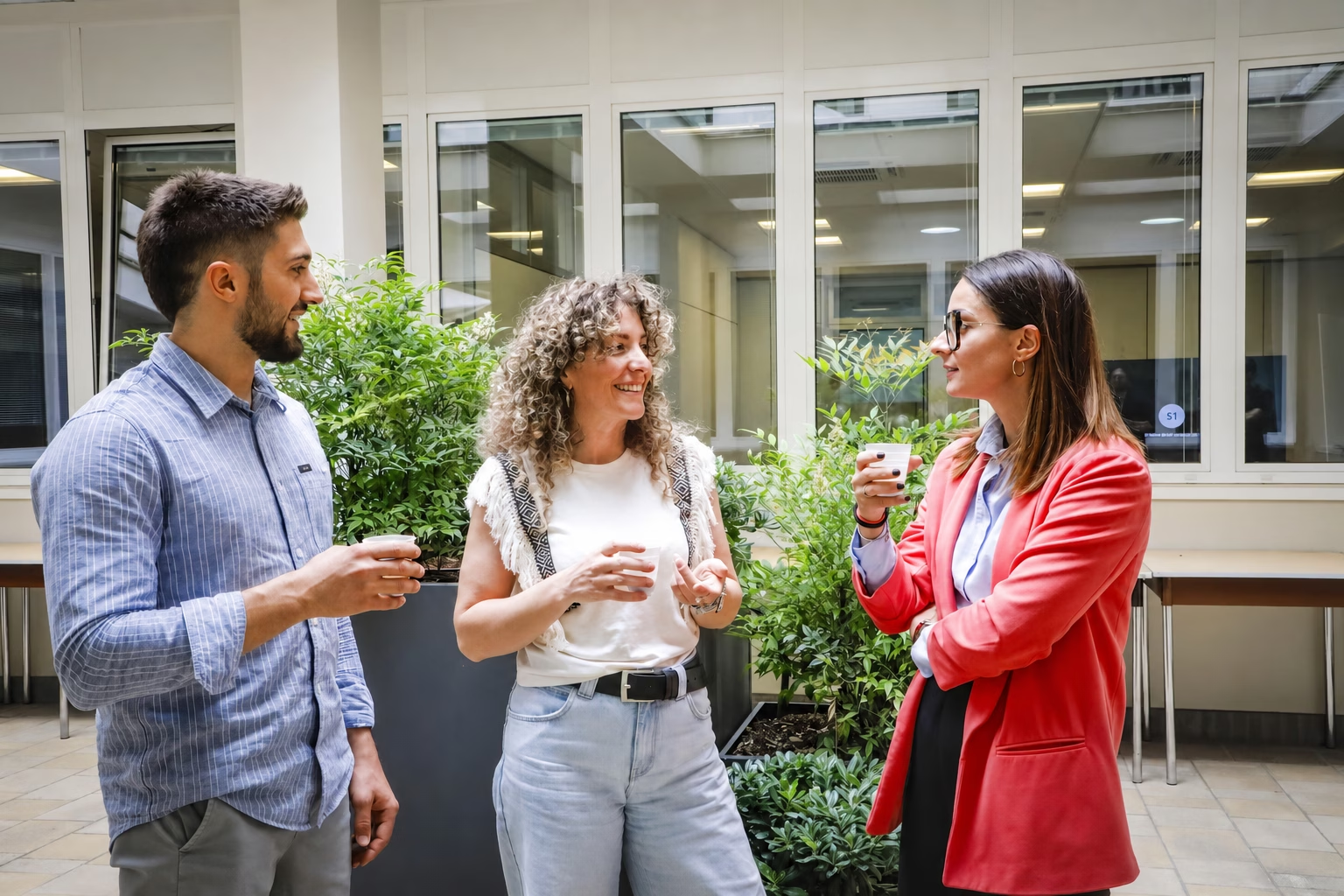
Together we talk about sustainability as a lever for economic transformation strategies and for encouraging investment that creates a positive social, environmental and values-based impact.
Luisa Grazioli:
Hi, nice to meet you.
Francesco Fanelli:
Hi Luisa, the pleasure is mine.
Luisa Grazioli:
As technical people, we are here to ask ourselves how sustainability can intersect with creating economic value, producing a value chain that is profitable both for businesses and for you, who are the ones who intermediate credit for us and give us the legs to carry out our activities and our projects.
Francesco Fanelli:
At UniCredit we are focusing heavily on sustainability. We believe in it and we are doing everything we can to support our clients on this journey, using finance as a lever, as an accelerator, because what we are seeing is that credit assessment and lending processes will increasingly integrate sustainability-related factors. Dialogue is essential – dialogue with supply chain leaders such as Camst – because this dialogue, beyond regulatory requirements, encourages the supply chain leader to bring the whole supply chain along, since we know that sustainability is not the challenge of a single company but the challenge of a supply chain, or sometimes of interconnected supply chains.
Luisa Grazioli:
Yes, at Camst it is in our DNA, because we are a cooperative with 80 years of history. Last year we made the very clear choice to become a benefit corporation, committing ourselves to hand our intergenerational heritage on to future generations a little better than we found it. Talking about economic sustainability also means raising awareness among all stakeholders – not only financial ones, but also our clients. Sustainability also means being able to measure yourself, being able to demonstrate that what you say actually translates into concrete action, and all this is clearly not a zero-sum game but an investment. It is right to talk about investment rather than cost because, in the end, being a sustainable company within the value chain and bringing all your stakeholders along brings a shared advantage that is, overall, certainly positive.
Francesco Fanelli:
Very often it is experienced as a regulatory obligation, especially among small and medium-sized companies, as an additional cost on top of the existing ones. In reality the key is precisely investment. If we see it as a cost, we will just do the bare minimum, and that bare minimum may be fine for reporting but it will not be fine for the market or for stakeholders, because economic sustainability means competitive advantage. So when a fund has to decide where to invest, it will certainly choose the company that not only has strong financial results but is also doing a great deal in terms of sustainability.
Luisa Grazioli:
The future is certainly demanding, because we build it ourselves every day. Discussing these issues and having an open exchange certainly brings benefits – benefits that also economically offset the investments and the efforts we are making to move towards this tomorrow, which, as we said, is a long journey. It is certainly not a 100-metre race where whoever gets there first wins.
Francesco Fanelli:
At UniCredit we always like to say that no one is sustainable alone. The sustainability challenge must involve all the actors and all the stakeholders. So when I think of a company I don’t think only of the company or the bank, UniCredit, but also of all the other actors involved: trade associations, institutions, municipalities, regions, all the various projects being launched. Our children will be our stakeholders of tomorrow, they will be the ones who judge us, and our goal today is certainly to hand them a better world. We all have to do our part and we all have to focus our efforts. So thank you again to Camst, because the more we talk about opportunities like this, the better. Thank you again.
Luisa Grazioli:
It means a lot to us, thank you.
Francesco Fanelli:
Thank you.