
People’s wellbeing in the workplace is also shaped by the conditions in which work is carried out: how time and activities are organised, the quality of the environment and the relationships that develop over the course of the day all help define the working experience as a whole. From this perspective, corporate welfare is not only about benefits and initiatives for employees, but also includes the aspects that accompany working life every day.
The lunch break is one of the areas where this attention can translate into real choices: the quality of the meal, the organisation of the service and the availability of suitable spaces all help shape the workplace catering experience and the role it can play in welfare and corporate performance policies.
The value of the lunch break: data from the 2nd Camst-Censis Report
But how much does the lunch break really matter to people at work? The “2nd Camst-Censis Report, Lo spazio e il cibo” (Space and Food) helps us answer, showing that a meal at work is not just a daily necessity, but also a meaningful moment for the quality of working life. In fact, 82.8% of workers believe that the lunch break at work contributes to their subjective wellbeing, while 89.6% of employees see the presence of a suitable space for eating at work as a sign of the company’s attention.
The social dimension also emerges clearly: for 82.2% of employees, sharing lunch with colleagues in a common space strengthens their sense of belonging to the team and the company.
The research findings therefore make it possible to explore the role of workplace catering from several perspectives: as a food service, as part of welfare policies and as an opportunity for connection.
Corporate welfare: caring for people also means caring about everyday life
The World Health Organization (WHO) recognises the importance of the working environment and organisational conditions in protecting mental health, highlighting the need to include the workplace in strategies to promote wellbeing.
It is in this context that the services available to employees also become relevant. Workplace catering is part of this discussion precisely because it accompanies a recurring moment of the working day, in which the quality of the meal and the conditions in which it is eaten are not separate from the service, but components that help determine its value for those who use it.
Workplace catering: the role of the meal and shared spaces
Workplace catering meets a concrete need of the working day: providing an adequate meal, at times compatible with work activities and employees’ needs. For this reason, the quality of the service is not only about what is on the menu, but also about the variety of the food on offer, the care taken in preparation and the overall organisation of the break.
Alongside the food itself, the environment also helps define the quality of the lunch break. The importance of this aspect is confirmed by the 2nd Camst-Censis Report, which highlights the value employees place on having a suitable space to eat. Being able to have lunch in a space separate from workstations makes it possible to step away from work and to set aside a recognisable time within the day for this moment.
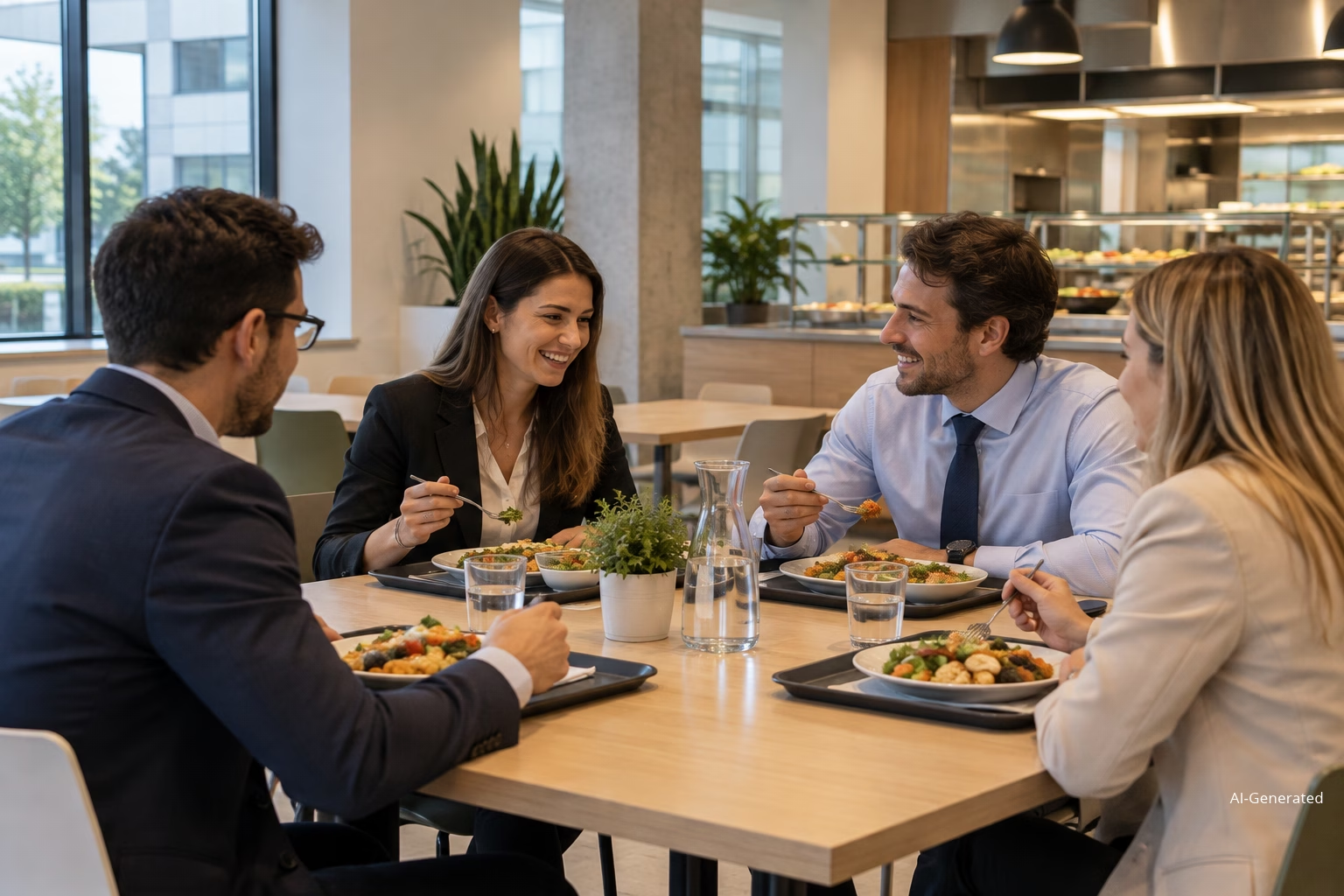
The lunch break can thus also take on a social dimension. Conversations that start over food create opportunities to get to know one another and to exchange ideas, alongside the relationships built during work. This everyday component helps explain why spaces dedicated to meals are seen not only as functional places, but also as part of the experience of working in a company. These aspects become even more relevant in light of today’s changes in ways of working.
Smart working and the lunch break: new eating and social habits
The spread of smart working has changed the way many people organise their day, including mealtime.
Remote working tends to strip the lunch break of its social dimension, reducing the opportunities for interaction that arise spontaneously in the workplace. The 2nd Camst-Censis Report highlights this difference: 54.7% of smart workers say they have lunch alone, compared with 39.2% of those who usually work on site.
Overall, 60.1% of smart workers experience at least one difficulty related to this moment of the day at home: these include a tendency to skip lunch or to eat it while continuing to work, the stress of preparing the meal and missing colleagues.
At the same time, 58.5% of those working in a hybrid model would happily return to the office if there were better spaces and services dedicated to sharing food. This figure underlines the value of the lunch break as an opportunity to meet, as well as a time dedicated to eating.
Habits are therefore changing along with ways of working, redrawing the boundaries between professional and personal time and changing the very perception of breaks.
These changes invite us to see the lunch break not as a simple pause in activities, but as a moment to be valued to ensure balance and wellbeing in the workplace. Understood in this way, workplace catering goes beyond the mere idea of a meal and becomes a true welfare lever, able to nourish not only the body but also the sense of community within the company.